|
BASC CHAPTERS |
|
|
| ECUADOR |
 |
President: Javier Moreira
Address: Cdla. Los Almendros, Calle Gaviota y Peatonal 5ta, Guayaquil, Ecuador
Phone: 593-42447801
Regional Chapters:
• Azuay
• Guayaquil
• Pichincha
• Umiña
Web: www.basc-pichincha.org/
|
| |
|
| MÉXICO |
 |
Avenida Niños Héroes N°2285 Int. 208 Col Moderna,
Guadalajara, Jalisco. CP 44190
Phone: +52 (333) 6794332
Regional Chapters:
BASC Ciudad de México
BASC Occidente
|
| PANAMÁ |
 |
President: Giomar E. González M.
Address: Paitilla, Torres de Las Américas, Blvd.Punta Pacífica y Calle Darién, Piso 9, Oficina B-901 Ciudad de Panamá, Panamá.
Phone: (507) 204-5719
|
| PARAGUAY |
 |
President: Jan Marc Bosch
Address: Avenida Artigas 552-1402, Asunción Paraguay
Phones: (595-21) 213 778
|
| |
| |
|
|
|
 |

 |
 |
 |
BASC -Business Alliance for Secure Commerce-, is an international business alliance, created to promote secure international trade in cooperation with governments and international organizations.
BASC is a private sector led and controlled coalition that has been supported by U.S. Customs and Border Protection (CBP) since its creation in 1996. As a non-profit organization incorporated in the State of Delaware as the World BASC Organization, the BASC is an international business alliance created to promote supply chain security in cooperation with government agencies and international organizations.
The BASC was created to address the problem of concealing contraband in commercial trade. As a voluntary program for businesses, with no government-imposed mandates, corporate participants are expected to follow BASC’s security standards which are designed to significantly improve their security practices and in the process deter contraband smugglers and terrorists from using their companies to introduce contraband and implements of terror in legitimate shipments.
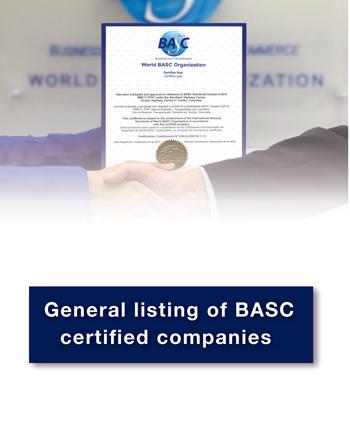
The BASC program examines the entire process of manufacturing and shipping of merchandise from foreign countries to the United States, emphasizing the creation of a more security-conscious environment throughout the supply chain. The BASC currently has over 2,500 companies that have been certified by the organization. And it operates in 13 countries of Latin America and the Caribbean: Colombia, Costa Rica, Ecuador, El Salvador, Guatemala, Haiti, Mexico, Panama, Peru, the Dominican Republic, Paraguay and Venezuela. |
BASC News |
|
11-Ene-2012 New international nomenclature enters into force The World Customs Organization (WCO) announces the entry into force on 1 January 2012 of the new version of the Harmonized System Nomenclature, the world’s global standard for classifying over 98% of goods in international trade. >>More |
28-Jul-2011 WCO Open Day for Trade reinforces Customs-Business partnership Participants from the business sector as well as representatives from Customs administrations gathered in Brussels to attend the Open Day for Trade organized by the World Customs Organization (WCO) from 27-28 June 2011 at its headquarters >>More |
28-Jul-2011 World Customs Organization (WCO) News Bulletin - July 2011 In the 65th edition of the WCO News Bulletin: "Trade Facilitation", you will find news such as: WWF champions “canine” Customs officers, Martyn Dunne joins the diplomatic world, Customs and business, equally reaping rewards from trade facilitation, and more. >>More |
28-Jul-2011 UNODC World Drug Report 2011 The document contains statistics and analysis of trends in the market situation of illegal drugs in the world. >>More |
30-May-2011 ECLAC Press Release (4 May 2011) According to an ECLAC report launched in Mexico City: Latin America and the Caribbean Was the Region with the Strongest Growth in Foreign Direct Investment in 2010. The Commission predicts that FDI will rise by between 15% and 25% in 2011 compared with 2010, but points out that the region should implement policies focused on innovation in order to better absorb the benefits of investment flows.
>>More |
29-May-2011 ECLAC Press Release (19 April 2011) In new edition of CEPAL Review: Researchers Analyse Changes in Latin American Middle Class and the "China Effect" on Exports The publication also tackles topics including the transmission of interest rates in two Caribbean countries and commodity prices in the region. >>More |
| |
|
|
|
|
|